
OCEO
Capture the weather windows others cannot

High-accuracy metocean forecasts for marine operators
Built on a twelve-year heritage of offshore operations and metocean expertise.
- Reduce missed weather windows
- Avoid aborted operations
- Improve operational planning
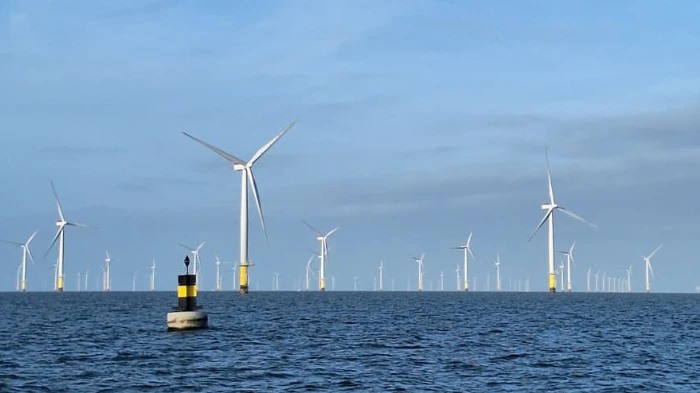
Forecasting built by Metocean Experts and Offshore Operators
What makes EOLOS different is our dual experience:
Extensive metocean knowledge built on more than a decade of offshore measurement expertise. EOLOS delivers high-quality data worldwide, underpinned by proven innovations such as our industry-standard Turbulence Intensity algorithm.
Strong operational understanding gained from executing more than 30 marine operations every year across the globe.
As both, data scientists and marine operators, we understand the real challenges of offshore planning: balancing weather risk, vessel availability, project constraints and operational risk.
Forecasts that Support Real Decisions
We navigate the complexity of decision-making in offshore operations. Our forecasts go beyond simply displaying data.
They provide the right parameters, incorporate local patterns, and operational context – enabling informed decisions within a single platform.
Plan marine operations with quantified confidence
Probabilistic metocean forecasts combine global numerical models, EOLOS observations and machine learning | turning uncertainty into actionable weather windows.
Fine-tuned Forecast with Site Measurements
Site measurements optimize forecasts for local conditions, improving accuracy and operational performance.
26%
Improved accuracy
< 1 m/s
Wind speed MAE
0,1 m
Significant wave height MAE
Probabilistic by Design
Monte Carlo realizations convert user-defined wave and wind limits into probability of operability, with uncertainty bands for risk-based decisions. OCEO works beyond fixed margins and allows choosing the confidence level that fits each operation.
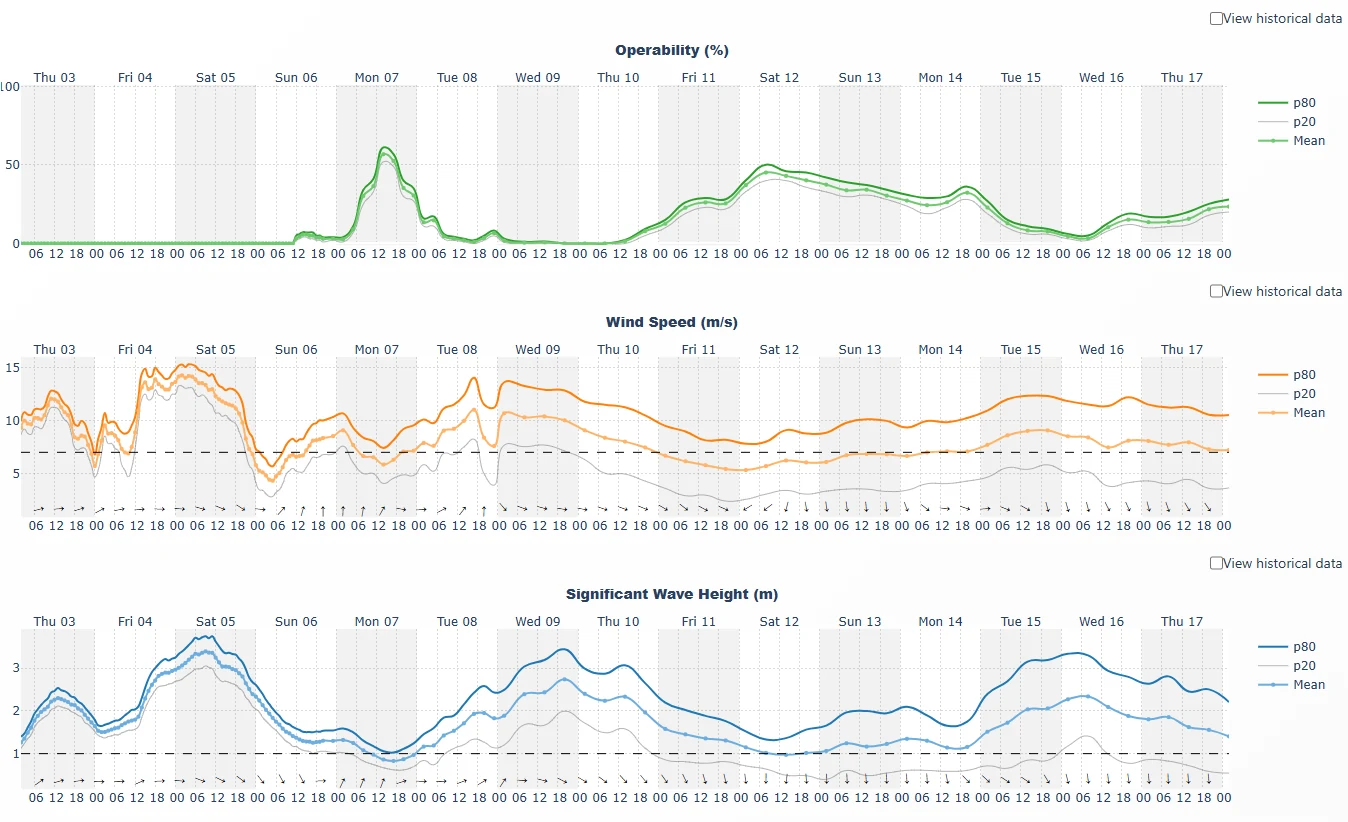
RISK ADJUSTEMENT TO GAIN up to 10 OPERABLE HOURS PER FALSELY PREDICTED EXTRA HOUR with respect to DNV standard alpha factor approach

Calibrated & Evaluated with History
Historical observations are displayed alongside each forecast to support daily calibration, drift checks and transparent forecast evaluation.
Validated Operational-Window Performance
25 sites • >5,000 days of data
+8%
Detection Reliability
With respect to global-model suppliers
−5%
Missed Windows
With respect to global-model suppliers
−4.4%
False Detections
Selected validated sites only; compared with other forecast suppliers.
+14%
Window Detections
Selected validated sites only; compared with other forecast suppliers.
Capture more viable weather windows.
Reduce aborted operations.
Improve offshore planning.
Delivery of high-resolution data every 6h and optionality to integrate real-time data and regional forecasts into the model.
Listing of operational windows, including duration and certainty ranges, for rapid assessment of conditions.
User-specific alerts and operational considerations
User-specific predefined thresholds based on:
- Type of operation
- Vessel characteristics and motion response
- Site-specific conditions
More than data display: featuring key parameters
- Wave: Hs, Hmax, Tz, Tp, Dir
- Wind: Ws, Wg, Dir
- Swell
- Currents
- Wind at height
while also accounting for interactions between them —such as: Current Dir. vs Wave Dir.; Tz vs Hs, Swell Dir. vs Hs Dir.